h g

Thursday, February 19, 2009

Small Farm Business: Taxes


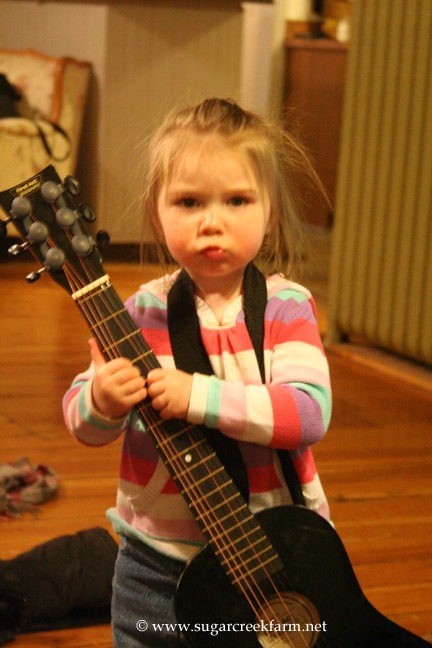
Tax time is nothing to sing the blues about!

Last night was our tax appointment, and believe it or not it's a fairly pain-free process for us. We were in and out in an hour!

Prior to starting the farm we always did our own taxes. But once we had to start filling out that Schedule F we enlisted professional help. It's worth every penny for us to not have to spend time keeping up on things like tax law changes or depreciation schedules on our breeding stock.

There are 2 things I do to make tax time go easier. One is to keep an "income tax" file folder, and during the year throw any documents we'll need at tax time into this file. Things like the kids' school registrations, property tax statements, vehicle registration papers.

The other is to keep a list on the computer of every paper document we need to take with us to our tax appointment - the things I just listed plus which banks we receive interest from or pay interest to, which investments we receive dividend statements from, our mileage log for the farm truck, etc. I did this a few years ago, and now each year I just pull up the prior year's list, update it, gather the listed documents, and go.

The final thing that makes tax time so easy is our QuickBooks program. I just print our accountant a Profit & Loss Statement, a Balance Sheet, and the detail on any assets we sold or purchased during the year.

We sing a happy song at tax time...


1 year ago:

And the answer is...

Labels:

Monday, December 08, 2008

Small Farm Business: Permission Marketing

I wanted to share a post I read recently about marketing called Reaching the People Who Get It. The gist of the article is that it's a waste of your marketing efforts to market to people who just don't "get it". This is the same conclusion Matt & I have reached in the years that we've been doing this farm thing.

In the beginning we thought all we had to do was educate people about our products and why they're so great and better for you than typical grocery store fare, and people would be beating down our door to buy from us.

Obviously, it didn't happen quite that way.

So now we try to target our marketing efforts towards people who already "get it", or at least might have an open mind towards what we're doing. The article calls this permission marketing - "when you market and pursue people who actually want what you are selling to them." But where do we find these kinds of people?

Farmers markets, to a degree. Some people that patronize farmers markets are there because they're interested in buying direct from the farmer, or in local food issues, or food safety or taste issues. Other people that patronize farmers markets are simply there looking for a bargain. After 2 years of doing farmers market, I'm getting better at discerning who's who when someone approaches my booth. I start with my basic rundown. If I sense they're in the former category, I keep on with the more detailed spiel. If I sense they're in the latter category, I don't waste my breath.

There's a local store that carries our meat. It's owned by a Mennonite family, and carries bulk foods and handcrafted furniture. It's been great for us, and I think great for the store as well. But we haven't even tried to sell through the other local grocery store. Earlier this summer that store set up a special organic products section. I noticed last week that it had been taken down. Just not enough people that "get it" shop there.

This winter I'll be giving a local foods class through NIACC Continuing Education. I anticipate that those who sign up for the class will be people who already "get it" - or who at least have an open mind to some new ideas.

Another way we hone our marketing to our target market is by managing our mailing list. Just like unproductive animals on the farm get culled, former customers who have stopped ordering get culled as well.

Marketing to those who get what you're about, rather than trying to educate and convert the masses, will be a better use of your limited time and give you a greater return on that investment!


4 years ago:

2004 Recap

3 years ago:

Jimmy

Winter cows

2 years ago:

Here are some pictures I took of a totally anonymous baby

Our Layer Hens, Part 1

Our Layer Hens, Part 2

Our Layer Hens, Part 3

1 year ago:

Snowy

I hate this time of year

Labels:

Monday, September 29, 2008

Sampling


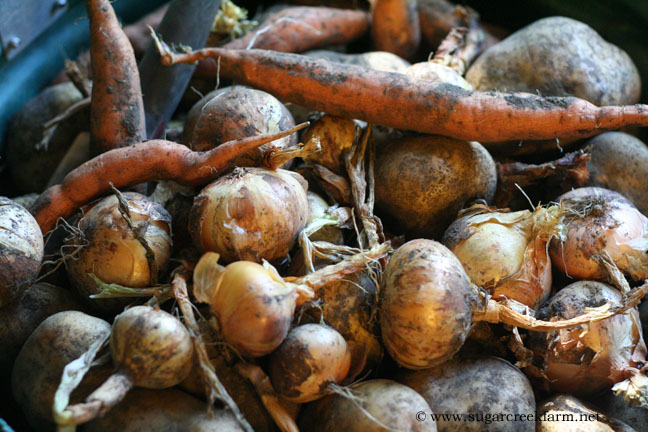
Potato and onion harvest

I'm usually reticent to give away very much of our product. Oh sure, I'll donate the occasional package for promotions that our farmers markets do. But by and large I find that other forms of marketing work better - and cost us less - than giving away meat. Last summer, for example, round steaks weren't moving. So one market day I typed up a bunch of recipe cards for my favorite round steak recipe and sold something like a dozen packages of round steak!

However we've come to the last month of market, and what we have on hand is a whole bunch of pork roasts and hams. Well, "whole bunch" is a relative term I guess. We have about 12 or 15 of each left. Not that many, really, but at the rate these 2 particular cuts have sold over the summer I was getting concerned we wouldn't get rid of them. Sometimes as the popular cuts sell out people will turn to the less popular cuts. But so far they hadn't turned to the hams and pork roasts. Could be because these are our 2 highest priced cuts of pork. But I suspected something else was going on.

We've had interesting conversations over the summer with customers, regarding their dislike for pork. The topic of "has the pork industry shot themselves in the pocketbook" could be an entire post in and of itself. Of course there are those that don't eat pork for religious reasons. But there's an unbelievable number of people who used to eat pork but quit, because they either hate the way pork in the grocery stores tastes these days or they're apalled at the modern confinement system in which most hogs are raised. Even when we explain that we raise our pork for taste, not leanness, or explain that we don't raise hogs in confinement it's still been difficult to convince people to give it a try.

So last Friday I went to market armed with a pork roast and a ham. I took my mom along to help hand out samples. And we sold half the pork roasts, and a third of the hams we brought along. Success!

So sometimes giving away your product is worth it. But another observation I made was that giving out samples gets people up to your market stand. And there's something about having people at your market stand that draws other people to your market stand. Curiosity, maybe. Safety in numbers, maybe. Competition, maybe. Those poeple might be getting a good thing and I'm missing out!

This can be difficult for meat sellers. The vegetable vendors can pile up the visual eye candy to draw people in. Even if we could pile up stacks of frozen meat on our table, it wouldn't be very eye-catching. I've seen meat vendors with portable, glass-topped freezers they can roll out to the front of their market stand so that customers can see the packages of meat inside. That helps, but our processor wraps our packages in butcher wrap so that setup wouldn't help us. Samples get people lining up at your table.

I won't be sampling regularly - I'm still not wanting to give too much product away for free. But I think last week's market taught me that there's definitely a time and place for sampling in my marketing arsenal.


3 years ago:

Lookin' for love

Eating a pig

Homecoming

Ouch

One hundred!

2 years ago:

Update!

1 year ago:

Hope comes in litters of 9

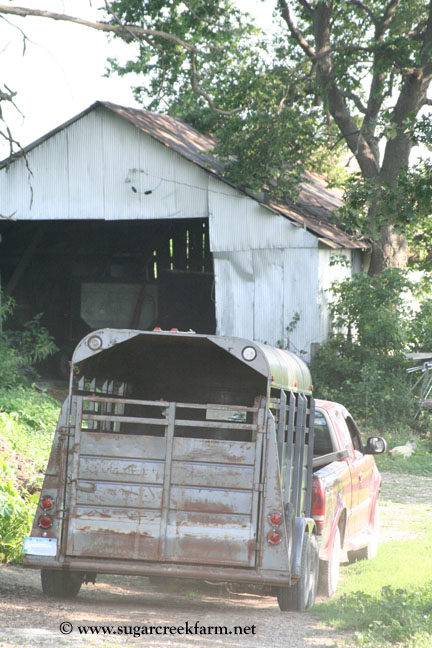
Barn still life

A quick hello from COS

Labels:

Monday, September 22, 2008

Fall


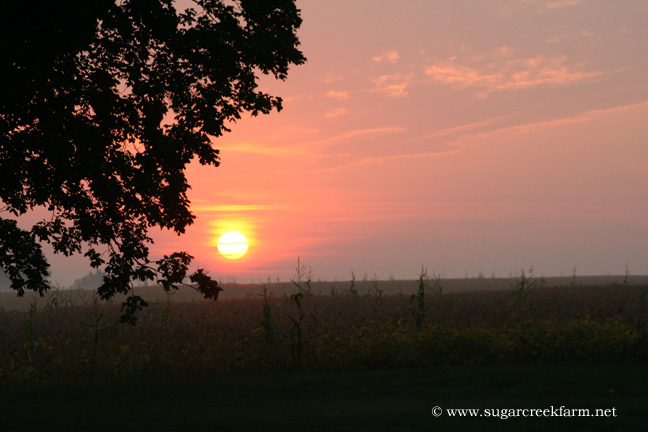
Sunrise at choretime

I've been rather absentee around here, haven't I? And when I am here I mainly write fluff.

It's not that there's nothing to write about. It's more that we've fallen into a rhythm here that's become semi-conscious, like when you've driven the same route to work for so long that some mornings you can't remember how you got there. It's a rhythm of morning chores, day job, afternoon chores, supper, homework with the kids, and bed. The rhythm is broken by various kid activities - school open houses, volleyball games, soccer practices. The end of the week is punctuated by 2 farmers markets, still. And somewhere in there we manage (sometimes more successfully than others) to get laundry done and dishes washed and maybe, just maybe, the checkbook balanced.

This time of year, in some ways, is like the top of the inhale. We're building, building, building to the coming harvest season when we'll let go of our held breath, a huge sigh of relief at having brought a bevy of animals all the way to butchering time. Of course that sigh of relief gets intertwined with the sigh of regret for those that we weren't able to get to this point.

In other ways this time of year is the opposite, more like the bottom of the exhale. For me it's one of the more stressful times, in my position as farm money manager.

Income is at it's yearly low. In truth this is a good thing, because it means we've sold everything we have to sell. It's always a guess as to how many animals to sell on-the-hoof, and how many to butcher for farmers market and other retail sales. But we hit it pretty much on the mark this year. With 6 Friday's left at one market, and 4 Saturday's left at the other, we've sold everything but a couple dozen pork roasts, a couple dozen hams, and 3 or 4 dozen chickens.

The question is, did we sell it at a high enough price to cover our costs?

At the same time income is low, expenses are at their yearly high. We're feeding all of these animals at the peak of their appetites, plus trying to build stores of hay and straw and cornstalks for winter. So we're exhaling, exhaling, exhaling, hoping we get to butchering (and income) time when we can breathe again, before we turn blue.

My goal is to someday get our cash flow to the point where we're not robbing our personal savings to keep the farm going. Maybe one of these years it will happen, unfortunately it's not this year. I admit I get more than a little cranky sometimes, thinking what that money could have done. Vacations not taken, our old farmhouse not to the point of renovation I thought it would be when we moved in 11 years ago. Is it that I believe so much in what we're doing, or am I simply too stubborn to admit failure?

I hope the jury won't come back with a verdict on that question just yet, whomever that jury is. Our family? Other bloggers? Other farmers? Friends? Neighbors? I imagine all of these parties to have an opinion on us. For sure some do, others don't no matter what I think they might be saying about us. But ultimately it comes, each fall, to a meeting of only 2. Farmer and farmer's wife, in the kitchen of this old farmhouse after the kids are in bed. A meeting that usually includes missed expectations, hurt feelings, some yelling, some tears, and some hope that next year we'll do better.

Interesting, that hope has so much weight so as to tip the balance away from all those other things and keep us from throwing in the towel for at least 12 more months.


3 years ago:

Silkies

Fall to do

2 years ago:

Happy little tomato

Happy Birthday!

They certainly don't look like the type of girls

A day at the auction

1 year ago:

Our late summer garden

Hawk (5), Ike (4)

Labels:

Tuesday, August 05, 2008

Lessons in entrepreneurship


Yesterday the last of Madeline's 4-H pigs went to the locker. A bit of a sad day for her, but all a part of being a hog farmer. And a hog farmer she is. Even though her own hogs are gone now, she still goes out every morning and chores our sows, boar and butcher pigs for us. I laughed the other day when she told a newspaper reporter, "Hogs are kind of my thing."

You might recall she started out with 8 pigs, lost 2 early on, ending up with 6 to choose from for the county fair. 4-H'ers are allowed to take up to 5 to the fair - a derby barrow, a derby gilt, a market barrow, a market gilt, and a 5th one to round out a pen of 3 entry. Hogs brought to the fair are not allowed to be taken home again. They must be sold right from the fair to the packer, at grade & yield market price.

In the interest of actually making a profit on her hogs, she decided she'd only take 4 to fair and sell the remaining two head directly. One of our customers even came to the farm to select and load their pig themselves (most of the time we select the pig and haul it to the locker for our customers.) Madeline helped them pick the one they took, telling them why she thought he was the better pig, and helped load him up.

We haven't sat down and figured her actual profit (or loss) yet, but I do know that she'll gross almost as much on the 2 head she sold directly as she did on the 4 head she sold at market price!

Labels: ,

Tuesday, July 01, 2008

Lessons in Marketing : Funky Chickens


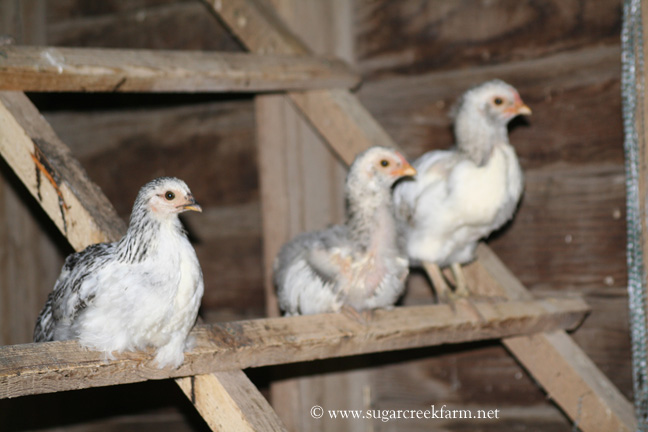
The hen's chicks are growing!

When we have chickens butchered, there are always some that come back as "double staples". The processor double staples the bags on chickens that are missing parts - some combination of drumsticks and/or wings. Usually we've eaten these chickens ourselves, or sold them to a customer who didn't get their pre-order in and is now desperate for some good-eating chicken :)

This time around I decided to try and sell these birds at farmers market. But how to market them? "Defective chickens" didn't sound at all appealing. "Irregular chickens" wasn't particularly catchy. Finally I came up with this and wrote it on my sign:

"Funky chickens - discount price!"

I had lots of people see that on my sign and walk up to my table chuckling to ask, "Okay, what is a funky chicken?" It got them engaged, it gave me a chance to "sell" them on the chickens, and got them to my table where they could see a list of other meat cuts I had with me that day. Some people decided they didn't want a funky chicken, but bought a regular chicken instead. And I sold every last one of my funky chickens. The selling point was, it's only wings or drumsticks missing so you get your white meat for less!

When we first started our business, marketing was something I dreaded. But I've learned to be creative and have fun with it. Now it's one of my favorite aspects of running a small farm business!

Click here to see past Small Farm Business posts!


3 years ago:

Finally

Labels:

Sunday, March 09, 2008

Small Farm Business: Enterprise Budgeting

The budget is where we start our "number crunching" for the year. There are multiple parts to our budget - a budget for each enterprise (beef, pork and chicken in our case) and an overall budget for the farm as a whole.

[Of course let me throw out the disclaimer that this is what works for us. This is by no means professional advice. I'm looking forward to hearing how some of you budget, so that we can continue to evolve our own process.]

Okay, so the enterprise budgets include only the income and expenses directly related to the enterprise.


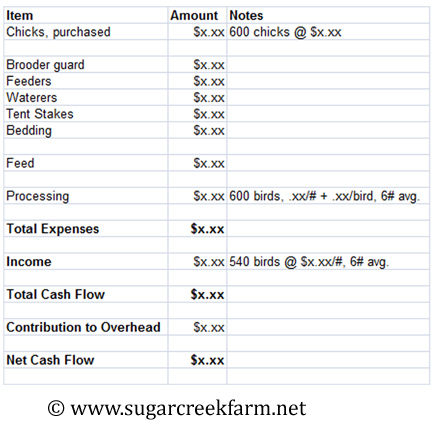
As you can see from our broilers budget spreadsheet, it's pretty simple and straightforward. The expenses basically follow the life cycle of the birds. You've got the cost of purchasing the chicks, supplies for brooding and finishing, feed, and finally processing.

Similarly, the beef budget includes expense items such as vet work (castration), the rent we pay for our hay ground, hired labor to make cut & bale the hay and cornstalks, and tractor expense because the tractor is used 95% of the time for beef-related tasks.

In order to be conservative, I budget feed and expenses for the full batch of 600 chicks. But for estimating sales & income I assume a 10% death loss, so out of 600 chicks I figure on ending up with 540 birds at butchering time.

With chickens income is simple to figure:

(average weight of your dressed bird) x (price per lb.) x (number of birds)

Or perhaps you're charging a flat price per bird (though I'll warn you there are labeling issues with this that you have to be careful with.) Then of course it's just (price) x (# of birds).

When it comes to beef & pork things are more complicated - we have on-the-hoof, wholesale, and retail sales. In a nutshell we project how many head we're going to sell in each category, for what price, and add up to a total income. In reality this is more complicated than that sentence sounded! I'll save the details for another post - if I can even manage to explain how we work our crystal ball!

Note that these are cash expenses. So things like depreciation are not included here. Depreciation is a non-cash expense that comes into play later on in the Profit & Loss.

See the category "Contribution to Overhead"? This is the amount that this particular enterprise is going to contribute to the general expenses of the farm as a whole - insurance, taxes, advertising, etc. More on that in the next installment in this series.

Even though we budget a year at a time, you certainly don't have to. The main reason we do it this way is that we send out one newsletter early in the year with our prices for the year in it. Depending on how you do things on your farm, and what enterprises you have, it might make more sense for you to budget over a shorter or longer timespan.

The thing about budgeting is that it's most difficult the first year, when you have no historical data to go on. So sometimes you just have to put out your best guess. Make some notes to yourself right with your budget about what assumptions you made to arrive at that guess. You'll reap the benefits of it next year when you go to do your second budget. You'll be able to see which assumptions were right and which were wrong so that you can make corrections.

So, do you budget? I'm guessing that there are as many ways of budgeting as there are farms. How do you budget?

Labels:

Thursday, February 21, 2008

Ask the Readers: Collecting Payment

Reader "ang" left a good question in the comments of yesterday's Small Farm Business post, regarding collecting payments from customers. This is a really important piece of direct marketing, so I thought I would throw it out to the SCF readers.

This isn't a problem for us when selling meat retail. The customer comes to the farm, or the farmers market, tells us what they want, gives us money and we give them their meat.

But when we sell beef & pork on-the-hoof, our customers pick up their meat right at the locker. They pay the locker for the processing costs at that time. We let the customer know how much they owe us for the meat, and they either drop a check in the mail or come out and pay us in person. So there's the potential there for things to get dicey. The locker only requires payment for the processing before letting them have their meat. They could pick up their meat and then stiff us.

It's never happened, knock on wood. But there have been a couple of times when we've waited a long time for payment. In that case I usually just send them a reminder in the mail about once a month. That's about as confrontational as I get. Once Matt made a phone call to somebody that hadn't paid yet, a couple of months after getting their meat. They did pay, another month later.

We're very willing to work with our customers that need special payment arrangements. If they need to wait on their income tax refund, or their end-of-the-month paycheck to pay us, we're fine with that. Those customers that talk to us ahead of time about how and when they're going to pay have never been a problem. It's the ones that you don't hear from, and don't hear from, and don't hear from that get worrisome.

What are some things we could do? I've considered having the customer leave a check for us at the locker when they pick up their meat. Or I could give the locker a list of those customers that have paid us, and ask them not to let meat go to those that haven't paid. But I hate to inconvenience our locker folks. They're busy enough.

One thing we probably should be doing is collecting a deposit when somebody places an order. When someone recently cancelled on us we were wishing we'd had a deposit from that person. It would presumably make people less likely to cancel, provide us a bit of "insurance" if they did, and give us a small advance to help cover the costs of raising the animal. Part of me thinks this is perfectly reasonable, part of me thinks I'm not placing enough trust in my fellow human, and part of me thinks the extra time keeping track of such things isn't worth it.

So maybe I'm a lazy pushover.

How do you (or will you, for those just beginning) handle collecting payments from customers?

Labels: ,

Wednesday, February 20, 2008

Small Farm Business: The Checking Account

When we first started our farm we took care of the farm expenses out of our personal checking account. We didn't have any farm income yet, so any farm expenses were funded out of our personal finances anyway. I used Microsoft Money for our personal budgeting and checkbook program, so I set up a "Farm" category there to keep track of what we spent.

One of the first action items to come out of taking the Grow Your Small Market Farm™ class was to set up a separate checking account for the farm.

Sure, for a while we were just transferring money over from our personal account to cover the checks we wrote. But having a separate checking account, among other things, puts you in the mindset of treating your farm as a business.

It also puts others in the mindset of treating your farm as a business - your bank, other businesses from whom you purchase goods or services, and your customers. Having an account with our farm name on it means our customers can make checks out to "Sugar Creek Farm" instead of to us personally. Hopefully this helps them take you seriously as a business and prompt with their payments!

The checking account, and the deposits and withdrawals in and out of it, become the skeleton for budgeting and accounting. After the first year you can use your checkbook entries to see how much you spent in what areas, giving you a base to build your budget for the coming year. You can also see when you had spending or income in each area, giving you a base to build your cash flow for the coming year.

It also makes tax time easier. Each entry, whether income or expense, will go directly into one or more categories on your Schedule F.

To take it a step further, I highly recommend using QuickBooks or some similar accounting program. This was another action item from the GYSMF™ class. By simply entering your checking account transactions into QuickBooks, and putting each transaction into a category, you suddenly have some extremely valuable reports at your fingertips.

More on QuickBooks later, but suffice it to say getting ready for our tax appointment now is a piece of cake. Matt spends about an hour figuring how much mileage we put on the truck last year for farm use. Other than that we simply print out Profit & Loss and Balance Sheet reports for our accountant. Our entire tax appointment tonight was a quick 45 minutes from start to finish (and included both personal & farm taxes and a lot of chattiness!)

Labels:

Sunday, February 17, 2008

Prequel


As I mentioned a few days ago, I’m going to write a series of posts about how we manage the “business” side of the farm. It is by no means a perfect process. If it were it wouldn’t take so long and I wouldn’t gripe about it so much.

We didn’t start out as a business. When we started our farm in 2002 with 4 Holstein bottle calves, it was just going to be a fun project for the kids to do. It would put a little money into their college accounts and put a little beef into the freezer.

But that all seemed to change when we made the conscious decision not to use hormone implants. Not using hormone implants is definitely not the “norm” around these parts. And when you do something that’s not the “norm”, be prepared to defend your actions. In researching our choice, I found out there was actually a name for what we were doing – “naturally raised”.

There we were, with 4 head of cattle but only needing ½ of one for ourselves. Why 4 head then, you may ask. Cattle are herd animals. When raised singly they don’t thrive as well and can literally die of loneliness. So you want at least two. Which means you want at least three, so that if one dies you still have two. And if you have three, what’s one more if the farmer selling you the calves happens to have an extra?

So even doing this just as a hobby, there’s still the business of finding someone to buy those extra 3 ½. In other words, sales. And for us, sales pretty much means talking to people. Spreading the word, mouth to mouth. And this turned out to work just fine. We were able to find takers for our extra beef the first several years.

After those initial years, our customers could pretty much be divided into 2 groups. The first group likes our beef because it tastes better than what you can buy in the store. Many people say it brings back memories of the beef their grandmother would fix for Sunday dinner. (And when we added pork and chicken we got the same comments.) It seems like people don’t even realize how different modern commodity meats are from the farm-raised meats they grew up on until they have some of ours. This group of customers doesn’t really care about the hormones and antibiotics. They just know good meat when they taste it, and they hadn’t tasted it in a long time until they tasted ours.

The second group of customers are the ones we say are “with the program”. They do care about antibiotics use in livestock, about implanted growth hormones, about humane living conditions for animals. This group of customers has been a little harder to ferret out than the first. The organic movement, the local foods movement, the sustainable agriculture movement all have been a lot slower to take around here than they have in other pockets of Iowa like Decorah, Des Moines, and Fairfield. But little by little people seem to be becoming more aware of these issues.

It was hard in the beginning because we were trying to target the second group of customers. But finding them was like trying to find a needle in a haystack. So at a certain point we took “natural” out of our marketing almost completely, and focused on the “old-fashioned” aspect of it that more of our customers seemed to care about. However this lack in the second group of customers will hopefully turn out to be a good thing, because it means we have a lot of room for growth in that market for this area. It’s just been at the farmers market this past summer that we’ve really started to market ourselves as “natural” again, and find people that are looking for that.

That still doesn’t really explain why we grew from hobby into small business. The short answer is passion. Or perhaps more accurately, a rediscovered passion. We both grew up on farms, but for various reasons didn’t pursue agriculture as a career. I could say a lot about those reasons, but that’s another post for maybe never. But even at this small scale we’ve rediscovered the passion for farming we’d had all our lives. We want our own children to have the experiences we had growing up. And making “good food” available to those who aren’t in a position to raise it themselves is a passion in itself.

The long answer would also mention that the farm just sort of took on a life of its own, and our passion let us get caught up in it instead of having an actual thought-out plan.

Where do we see ourselves evolving to in the next 6 years? Believe me, the thought gets voiced every so often that maybe we should go back to hobby status. We can’t say as we’ve made a true profit in any of these years, through a combination of continuous growth, stupid mistakes on our part, and economic factors beyond our control.

What does any of this have to do with budgets and cash flows and business plans? If it were still a hobby we wouldn’t need any of those things. And perhaps there’s someone reading this that’s still at the beginning. Perhaps sharing our mistakes will save someone else the trouble.

To be continued….


Related posts:

Why we do this

Inspiration


3 years ago:

Houseguest

BWD

2 years ago:

Photo Friday: Baby

Labels: